Showing posts with label Dominican Republic. Show all posts

Sunday, May 31, 2020

Black Lives Matter: From Emotion to Strategy and Solutions


Opened my history book to take a better look
At where we came from and where we’re going
Without a sense of time
You’ve got no ears or eyes
I see a broken rhyme called human learning
You know this is serious
We’re repeating things we’ve done
Do ya wanna be a part of the solution?

-Solution by Paul Colman Trio

I spent many years finding out about world events long after they happened. I have lived in the Dominican Republic for 12.5 years. I am busy and removed with a large family, work, and studies. However, we’ve been on lockdown here since March 18th and I have been paying more attention to the news due to the coronavirus. It is amazing and interesting how the topics that spread through my social media feed change daily.

I am very glad that I have been so attentive to world events; especially U.S. events because so many of my family, friends, and contacts on social media are in the U.S. I was shocked and heartbroken by the announcement of the murder of Amaud Arbery while innocently jogging, especially since his murderers were not yet arrested at the time of the announcement. I was in disbelief when I learned of the horrific murder of George Floyd so soon after the arrests of the Amaud’s murderers were finally made.

The events that took place the days following George Floyd’s death were very revealing. I am specifically referring to the fact that the four officers, while they were fired, were not arrested right away
after such a brutal murder was caught on film. A CNN reporter who happened to be black was arrested while reporting the protests. The words spoken by the president in reference to the riots, especially when compared to words he spoke about white armed protestors in Michigan during the coronavirus lockdown exposed incredible bias.

 I think it’s safe to say that many who were not convinced that racism is still an issue in the United States and that the police brutality used specifically toward black and brown people deserves serious attention now see differently. I feel hopeful for future change that will be taking place, but there is work to be done to bring it about.

First of all, let me address something that will probably be important for many to consider my thoughts on this issue. I am a white woman. I was born and raised in Virginia. I moved to Puerto Plata, Dominican Republic permanently when I was 22 years old, having recently graduated from Virginia Tech. My husband is a black man from Haiti. We have three biological children and two adopted children.

As I mentioned, I have lived in the Dominican Republic for 12.5 years now. I have not lived in the U.S., and have honestly not spent many days there at all, throughout all of Obama’s terms and Trump’s. My race causes me to be a minority here in the Dominican Republic. To racially describe the Dominican Republic in a nutshell, it was the first place Columbus landed in the New World and was settled by Spain. They kidnapped people from Africa and enslaved them, but when slavery ended, the races became very mixed. The population that would be considered white in this country is very small. The population displays a beautiful array of skin color shades and there is no shame in calling someone by their skin color (indio, moreno, rubio, negro, kle, wouj, etc.) The race of the neighboring country Haiti is primarily what we would call black. If you haven’t studied Haitian history, I highly suggest that you do.

I have met many white friends here through Project Esperanza.
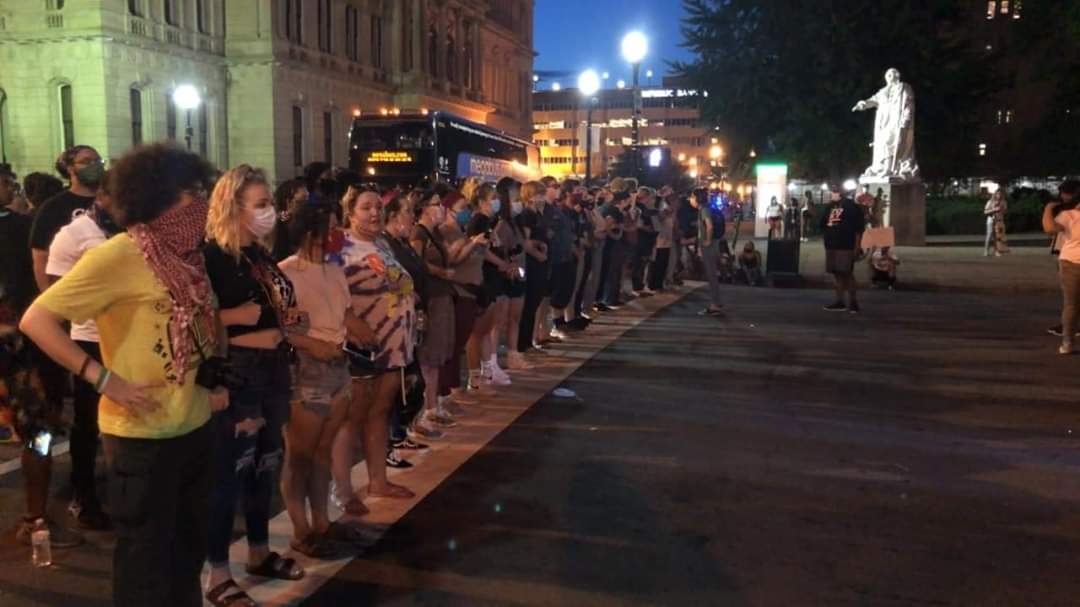
Line of white protestors stand between police
and non-white protestors.
However, they don’t live here. They visit. So on a daily basis, I am the odd one out in that way. I don’t usually even see someone that America would refer to as white, other than perhaps tourists in passing. My kids used to point and say “Look! Volunteers!” whenever they saw white people. I may be referred to as gringa in Spanish or blan in Creole. I have had to correct people many times and let them know how I feel when they talk about blan or gringos. I think about things I say and am held accountable if I say something that offends someone.
This isn’t to say that I have walked in the shoes of an African
American woman who grew up in the United States. I have surely not. I realized that I was unfairly privileged for many reasons in addition to race while I was growing up and felt guilt over the issue. This is largely why I wanted to use my privilege to serve situations that broke my heart.  Nonetheless, I do think I have some insight that I would like to share and engage in dialogue about. 

As I said, I’ve noticed that social media themes change daily. Yesterday and today I see that many are questioning rioting and how effective it is or was in this case. People are comparing Civil Rights Movement protests that were peaceful, strategically planned, and completely respectable, to the chaos of looting and burning. Perhaps only God knows if the rioting hadn’t taken pace, whether the killer would’ve even been arrested, and whether other factors would’ve changed in addition. Yes, it’s sad that rioting took place and is still taking place. However, war is always sad, isn’t it? War is a result of groups of people that were not able to effectively communicate and reach an agreeable compromise. Additionally, many people are just taking advantage of anarchy, which wasn't the intent of most protestors and isn't their fault. 

What are you going to do to protect your city from these problems that could lead to rioting, if it hasn't already? The ONLY humane solution is to effectively communicate and reach agreeable compromises on a consistent basis. The responsibility here is on
each city’s leadership to initiate this process. Take a knee and engage the people rather than shooting tear gas and rubber bullets, (both literally and figuratively). However, where this doesn’t happen, churches, schools, and organizations exist and can initiate such communication. The bottom line is that this is not the responsibility of the black community to make themselves heard. There have been plenty of cries. I particularly teach my kids that whenever they hear someone cry, they should ask what's wrong. It doesn't matter if that person cries a lot and you are used to hearing him or her cry. It doesn't matter if the person even hurt themself. You cannot hear someone cry without asking what is wrong. Every single time they cry. It’s each community’s job as a whole to reach out to the black community and listen with opened minds and hearts. The insight provided will show the direction in which each community needs to go to create needed change.

This site (www.mappingpoliceviolence.org) provides statistics about police violence in the U.S. Simple practices such as requiring the reporting of any use of force, ban of chokeholds or strongholds, and requiring other officers to intervene if another officer uses excessive force drastically change statistics. A Canadian friend recently informed me that in Canada, a report must be filed
whenever a police takes his or her gun out of their holster. This practice puts weight on the very act of taking out a gun, AS IT SHOULD. There are things that can be done. Sources say that progress was being made in this area during the Obama administration, but went in the opposite direction under Trump's direction. READ ONE SOURCE HERE.

And then there are cases such as George Floyd’s where the gun was not the lethal weapon. However, the killer and an accomplice had quite poor records with many red flags raised. I have to agree with my brother Matthew McHale who posted:

“We have a system designed to protect police at all costs whether they behave correctly or not. It gives them a sense of being above
the law. It should be the opposite. They should be held to a higher standard than the public given the power they are wielding. Any abuse of power should be harshly punished and not tolerated.”

My friend Maryann Glascock stated, “I think it’s just far too easy to get a badge and a gun with all the authority in the world. Police officers are public servants and we pay their salaries through our taxes. I think we need to increase police officer salaries to hire more qualified people or use the money to provide more training to the people they are hiring. I’d be happy to see my tax dollars going towards that”.

When one examines how funding toward law enforcement is allocated, it probably wouldn't be necessary to ask taxpayers to increase anything in order to pay police more in order to recruit higher qualified individuals. It would simply be a matter of diverting money spent on weapons and potentially excessive police presence toward salaries. The Black Lives Matter campaign is leading a petition for police defunding. If you READ HERE, what that really means is a diversion of funds from investments such as "military hardware" and allocating those funds toward after-school programs, mentoring, and other preventative efforts.  

I agree with all of those points. I also feel strongly that there should be a campaign to recruit minorities into the police force. I understand that those who feel targeted by the police are reluctant to become police officers themselves. Black police officers are criticized by other people of color for choosing that profession. However, this is creating more of a problem than a solution. If there was a black police officer on the team that set out to arrest George Floyd, do you think things would’ve gone down the same way?

Rather than criticizing black or brown police officers, the black community and the community as a whole should celebrate them, thank them, and let them know that they are heroic in many ways. After all, police officers do risk their lives. We know that not only do police officers kill people sometimes, but they sometimes get killed as well.

I imagine images flying around of black or brown police officers and black or brown children dreaming of becoming police officers. “This is my community. I will uphold and protect it.” There should
be a sense of ownership and pride over the community. This should be a point of dialogue. If there is not that sense of community, then why not? What can be done to change that? Incentives should be developed as have been developed for the army where special scholarships or other benefits should be granted for people of color who will serve as a police officer for a certain number of years, and other such incentives. Priority should be placed on this! Of course white police officers would be jealous as with any affirmative
Protestors protect a cop who
got lost from the others. 
action but that shouldn’t be a reason not to do it.

Let me now say that anyone in the black or brown community feeling discouraged, exhausted, fearful, etc. should know this.  You may not benefit from white privilege, but you are so very privileged. I say this not to belittle anyone's feelings or to ask them to stop complaining or protesting. Share and protest (peacefully) all you want! I support you! I say this to share a truth that I can see from a different perspective as someone outside of the U.S. which some people may forget or not be fully aware of.

I am very sympathetic to and heartbroken by these recent cases. I have lost lots of sleep this past week thinking, reading, and talking about it. However, the truth is that I often brush off issues in the United States as “first world issues”. You think your public schools are bad? You think your minimum wage is low? You think your low income communities have it rough?

Being an American citizen, no matter where you are on the unfair spectrum, is a HUGE privilege. Nowhere else in the world attracts immigrants like the United States, and many cannot get in, even illegally. As a citizen, you have access to so many benefits, including student loans, loan forgiveness programs, welfare if needed, public education through high school absolutely accessible to all, and the list goes on! To put this into perspective, many of the youth I work with have
missed years of school because no public education was available to them and their family couldn’t afford private education. READ MORE HERE. In 2013, the highest court here ruled that Haitian immigrants that had been in the country for up to four generations would potentially have their citizenships removed, depending on the migration status of their parents, grandparents, and great-grandparents. Minimum wage in this country is $200 per month for someone working 44 hour work weeks. These are just a few examples.

Additionally, having English as your native language is a privilege. I have a strong advantage with many online work opportunities I have done and looked into because of this privilege. However, I fully understand that just as a child who grows up in a loving, united lower class family may turn out more well-rounded and have a happier life than a rich kid who has a lot of toys and gadgets, but a cold family life, the effects of feeling like the underdog or whipping boy in society can be emotionally debilitating, keeping groups of people from reaching their potential despite available opportunities. Some would even say they feel as though society hates them. It’s a complex issue. And please don't think that by mentioning these benefits available to American citizens that I don't acknowledge all that has been denied to black American citizens throughout history since the Civil Rights Movement and the struggle it has been. The recent events are just a sample of proof that was made visible to the world, representing centuries of the same cold heartedness. 
Although the oppression still goes on, as has been witnessed so clearly lately, we shouldn't lose sight of the progress that has been made through the Civil Rights Movement. There are many amazingly successful African Americans in the United States. Two of my personal favorites who I’ve watched and loved since I was little are Oprah Winfrey and Will Smith. How many black Americans have become millionares through professional sports? Do we realize what a small percentage of the world has such an opportunity? While there is still work to be done before we can say that true equality is being practiced in the U.S., no one should let the horrific stories like George Floyd’s take away from the countless successes. And as they say, we're not going backwards.

Therefore, in reference to black and brown readers, if you can keep a global perspective, you may feel more encouraged by remembering that despite what it may look like in your home town, you are actually on top of the world! You also could consider spending time in or even relocating to a country like the Dominican Republic where your race would not make you a minority. Project Esperanza would love to have you as a short term volunteer, or even serve as a year or two as volunteer coordinator. 

In response to the George Floyd case, black Americans who have relocated here were posting about how grateful they are that they had done so as they don’t face the same fears of police brutality
here. And for any white Americans that would like to remain in the majority with these changing times where whites will likely no longer be the majority within the next few decades, you could consider going somewhere like Australia. I suggest this (and don't actually expect anyone to even take it seriously but you never know) because it's an English speaking country that is not too cold and there is a strong white majority. The point is, there is surely no changing the direction that the U.S. is going. The only choice is to embrace it. 

Anyone who is offended by the light suggestion of relocating should realize their American privilege right there. Do we deserve to stay in this promised land we call the U.S.A. generation after generation? Did we ourselves build it? Rather than fighting to keep others out and maintain it a certain way, why don't we explore other parts of the world and share our best practices? CHECK OUT MY TEDx TALK for more thoughts on this. 

For anyone at all wanting to teach their kids about race issues, I highly suggest watching the Netflix series Family Reunion.  There are a few episodes that deal with police brutality, reporting the officer, and consequences for the officer, starting on Episode 10. However, the whole series is great. MORE ON THAT TOPIC HERE.

It’s encouraging that so many are taking a stand and showing they
MLK's tomb site during a protest taken
by Project Esperanza
board member Edna May Hermosillo.
care by at least speaking up on social media. I hope and pray that the follow-up remains strong and these cases are seen through. If the murderers of Ahmaud Arbery and George Floyd don’t get a just punishment, then a lot of the efforts put forth so far will have been in vain. Also, we have to continue to share insightful information with others. Racism isn’t something we recognize when it’s never challenged and those who are in very homogenous groups can benefit from these insights that they might not be exposed to otherwise.

I saw some posts about “policing the police” where people who see what seems like potentially an unnecessary amount of police officers around a car or individual stop and watch the situation to make sure there’s no foul play. I also saw, “stay with my son” which means that you stay with the black male being questioned by police until it is over to also make sure there is no foul play. These both seem like great efforts and ideas. Let’s keep it up!

I am dying for raw, honest, tranparent dialogue on this issue. Please share your thoughts in the comments. Let's work through this together! Thanks! 


2,000 years ago the greatest radical walked the earth and said we are forgiven souls
Have we forgotten him and made religion king? Love and grace is what we should be offering
You know this is serious
We’re repeating things we’ve done
We must be delirious thinking it’s new under the sun
Do ya wanna be a part of the solution?
To be one, to be one, to be one is the solution, yeah, yeah! 
Junior Jean
Unity is Strength (taken from Haitian Flag)
A cord of three strands is not easily broken.
www.GoodFruitDesigns.com


Tuesday, July 5, 2016

Street Census Redone


When Project Esperanza first came to Puerto Plata as a Virginia Tech student organization in the summer of 2006, we conducted a street census with the understanding that the results would be submitted to Integracion Juvenil, a Dominican foundation, that was opening up a home for boys on the streets. We created 140 profiles over the course of one month and submitted the information to Integracion Juvenil. We were told that Integracion Juvenil rejected the profiles as 96% of them were of Haitian youth and adolescents, and they did not intend on receiving Haitians into their home.


This is where our work began. The average age reported was 14. We were told that some of these kids were living with “bosses” who sent them out selling and then took their money at the end of the day. Very few reported living with family, and those who did reported living with a brother, a cousin, or an aunt, but not their nuclear family (mother, father, and siblings). The original profiles were lost in a damaged hard drive before we could collect the exact statistics, but it was remarkable to us that 0% of the Haitian youth reported currently attending school. Some had reported attending school in Haiti before coming to the Dominican Republic, while others reported never having gone to school before. Probably 85% reported living in the barrio of Padre Granero, where we began running a school shortly thereafter, whereas the other 15% reported living in the barrio of Agua Negra on the other side of town. When asked why they came to the Dominican Republic, they all said, “to search for life”. Haiti is the poorest country in the Western Hemisphere, so it makes sense that so many venture over to the other country that shares the island with them in hopes of finding “life”.


At the end of the month long census, some found out where our volunteer house was located and they began coming by in groups asking to see the photos we had taken of them for the census profiles. We were sad that the home we thought we would be able to lead some of them to through Integracion Juvenil was not going to be a reality for them. So we began a lunch, tutoring, and recreation program at that time from noon to 4pm. We began learning much more about them and over time, some did disclose their stories.


Someone in Haiti, normally a neighbor, had convinced them to come with them to the Dominican Republic. Sometimes it was with a parent’s consent, and sometimes this person had convinced them to come in secrecy even when the parent did not consent. They promised the boy that life would be better in the Dominican Republic. They would find bikes on the ground easily that they could have and ride, radios as well. They would go to school and eat better meals. Then when they arrived, they were often made to live harsh street vendor lives where they wake up early, search for wood to build a fire, and prepare sweets to sell on the beach. They were taught a route they would walk all day long to sell sweets on the beach. When they arrived home, they would turn their money over to the person they live with, and do an accounting. Some reported harsh punishments if they did not sell all of their sweets. Some showed scars where they reported being hit with machetes. We went with one to the hospital where the doctors found he had internal bleedings from beatings.


Some boys had even reported during the census that they lived with their father, and then we came to find out that the man they lived with was not their father, but someone who had brought them here in this manner. Over time, we found out certain men who were involved in this trafficking business. Women were involved in the kidnapping and enslaving that was going on here as well. It was a quite common practice. It is for this reason that we sent close to 50 youth back to Haiti to be reunited with their families who they reported being tricked. Their families thought they were doing a good thing for them. The adults running these operations said that their parents knew what they were sending their kids to. They didn’t want them or couldn’t take care of them. That is why they sent them.


We did not do the street census again until this year, 2015. I had thought about it in the past and quite frankly the idea scared me. The need and sadness we found during the first census was overwhelming and running an organization that was attempting to respond to the need had taken over my life. We have some great success stories from the first street census. Some young men who had never attended school before are now close to graduating from high school. Some have steady jobs. Some have started families. Some have been more responsible in starting their families than others. Some are here in the Dominican Republic while others have settled in Haiti. But we have lost some as well. Others spend time in and out of jail. 

Anol
I wrote a tribute to two we lost, Anol and Etienne, in the book I published, but since then we have lost two more. We have lost two of the first three who we offered mattresses on the floor to in 2007 when they reported sleeping on the beach or on someone’s porch. Both were scarred and problematic boys but had they had the chance to be given a permanent and loving caregiver and secure home and family, they could’ve done great. I am talking about a foster or adoption situation. Yes, they were a part of our group home, but both fell back into the streets as they needed much more individual attention than we were able to give them at the time. Here is a group home video from 2015 memories. The last slide which mentions Michael and Tina Reeder is actually out of date. For family and health reasons they unfortunately were not able to stay for the year they had hoped for.


I won’t neglect to say that it saddens me that so many volunteers (although not all volunteers) came and met these boys and then returned to their lives in the U.S. without doing anything to better the boys’ lives. Maybe these volunteers had other things going on in their lives that kept them from doing that, but I just think that if I have dedicated pretty much my whole life, then more could have at least written from time to time to ask how so and so was doing. I am not saying this to pat myself on the back or put others down but it is truly something that I have a hard time understanding. We all (volunteers) have our nuclear families, quality education, secure housing, food security, and job opportunity. I don’t think anyone can say that their problems have been too great to spare an occasional check in. Anyway, what is done is done and I hope we can only move forward for a better future. 


Alin did not last long in the group home. When there were 18 boys in the beginning (we tried to help everyone) and lots of fighting and power struggle, he requested to be sent to Haiti to visit what family members he had there. Upon returning, we did not allow him back
into the group home because he had many accounts of stealing and
Alin
other vices. However, had he expressed extreme interest in coming to school each day as others did, he may have been given a second chance. He did not. He continued to come to soccer practice some. Then I didn’t see him for quite a while. A few years ago, Jonel told me that Alin was in jail in Santiago and needed someone to sign for him or represent him at his hearing. I said that I could not. I was just overwhelmed with responsibilities and he had not maintained contact as others had to the point that I felt like I could vouch for him in any way. 


It was maybe a year later that I asked Chinaider about Alin and he said that Alin had been shot and killed in Sosua. The police shot him as he ran away from a theft. In law school, I learned that deadly force cannot be used to stop someone from theft or anything that doesn’t create extreme deadly risk to others. Someone running away from a theft should not be shot. However, here you hear of this sort of thing without repercussions to the shooter. I did not learn about this until after he was buried. Chinaider thought that he was buried in Sosua. 


Luis did not return to the group home after he stole a laptop from the administrative space he broke into in a separate building in 2008. He lived in town ever since and lived a fairly calm life. I never heard of any more problems from him and he did not seek any more help from me or any teachers or employees. He seemed to play a lot of Nintendo and eventually found a job with the trash truck. He even attended the public night school in town regularly and would have started 8th grade this year. He was very scarred. I wrote about him in this blog post. Luis is the boy I was referring to who was said to have been used by the police for violence in Port-au-Prince.  


Jeres told me this past summer that Luis had gone to Haiti and was very sick. I was busy and did not ask and was not told anything further for over a month. Then one day recently we drove through the area of town where he lived and I asked Chinaider, who was in the car, for an update on Luis. He replied with, “Luis died”. He said that someone had taken him to family members in Haiti and he died within a few days. When I asked what sort of sickness he had he said that he became extremely thin and had no appetite. That is all I know.  


Rest in peace Alin and Luis. 


Bobby is someone who was in the group home until 2009 when we made contact with his mom and heard of the true story that he was pretty much kidnapped. We sent him back to her and she was so grateful. He came and went after that. He basically lived in between our group home, his mom’s house in Haiti, and another area where he had contacts in the country and worked in agriculture. Every time he came he had a really hard time living in a group setting and managing resources in a humble manner. By this I mean that he always ended up getting into a conflict because he owed someone money or took someone’s stuff. He is an extreme people person and makes friends everywhere but gets into conflicts when he owes money, etc. He didn’t deny his involvement in drugs from a very young age before he was ever in the group home but I do know he was clean for the most part before we sent him to his mom’s house in 2009. But it looks like at some point he fell back into that. 

Normally when he would go to work in the country, people would then report him buying drugs and stealing things. So this may be the root of his problem. 


The last time he was here and left was not even a year ago but without going into too many details, I didn’t want him to come back and didn’t plan on talking to him when he did come back. He turned 21 in January which is the age that we completely kick someone out of the home. At 18, they stop receiving aid with food. However, we had not let him back in the home for quite a while because of these reasons. He stayed with another young man who had graduated from the home, named Biby. Biby knew I did not want to see him, but nonetheless, came with him to my house when he arrived again. My house is next to the group home and was just one street over from Biby’s house at the time. I did not go outside to talk to him when they called me. They eventually left. Biby then saw me leaving later on that day and approached me. He said that he was not planning on accompanying Bobby to my house, but had done so because he sees that Bobby is now crazy. He arrived this morning and isn’t making any sense. It also seems like both of his thumbs are paralyzed. I listened, was surprised, and went on my way. 

The next day Bobby approached me when he saw me on the street and I was able to converse with him and see what Biby meant by “crazy”. He made some sense and remembered everyone, but did seem handicapped. A day later he had a tank top on backwards… one with a scoop neck and high back that was very apparently on backwards, but he did not notice. He speaks quietly and is unable to completely convey his thoughts, which seems to frustrate him a little. He walks around during the days and looks for work. He was caught stealing a bag of bread at a colmado down the street but they went easy on him when people told them that he was crazy. So we’ll see what happens. I am not sure what I can do for him unless someone really wants to take on his case. And even then, I don’t think I should personally be too involved with him directly as I would not like to give him any sort of welcome into my personal space. But someone else in the organization could perhaps help. 

9 years after the first census, I realized that it was time to delve in again. We started with winter break volunteers sitting in spots around town with a clipboard and a camera. This time we gave out bags of rice, beans, and a packet of oil as a thank you for participating in the census. Spring break volunteers participated as well up until May. Our summer volunteers did other activities but I still got a few profiles going around town in the summer as well. The results are quite different than 2006. In 2006 we divided into two groups and did it for one month, so probably 22 weekdays. We conducted the census in the afternoons. This consists of 44 half days. This year we did 15 half days and then I did a bit independently. Therefore, more time was spent on this in 2006. But it was very clear that in 2006 there were simply more youth working on the streets. Tourist police have completely banned two touristic areas to such street vending among youth: the Malecon or Boardwalk, and Central Park. Also, attempts have been made by the government to eradicate child labor in general. Of course we find many teenagers street vending and do profiles on anyone who reports being 18 or younger, and those older ages don’t count as child labor. But there was a significant lower amount of 10 and 11 year olds on the streets during this census. Additionally, it might be due to the fact that we did send around 50 kids back to their families in Haiti and started registering kids in school, and rewarding them with things for going, but the men who were highly responsible for the child trafficking in Padre Granero when we first began seem to have stopped doing that altogether. I haven’t heard of such activity in years.
The most alarming thing we saw during the 2015 census was not kids who were estranged from their families and living as servants, but two cousins and a sister. They live with their parents and say they go to school, but they can be seen often in the dark far from home selling peanuts. I drove the two boys home one day as it was dark and they were at La Sirena when they live far away from La Sirena. They fell asleep in the car and I made it to the area where they said they lived, then asked people on the road if they knew where the boys sleeping of my car lived. We eventually found their family. I talked to them about why they sent their kids out to work on the streets like that alone and until very late at night. They said that an adult usually went with them and would go with them in the future. They have financial needs. I said I would try to find some help to get them some groceries each month. And not to send the kids out anymore! Especially alone! I still see the kids very often, sometimes accompanied by an adult, and sometimes not.

Wednesday, April 23, 2014

Published Book!

This post will be short and sweet. I've gotten a lot of requests throughout the years to publish a book. I have gotten these requests in reference to my many updates from the ground here in Puerto Plata, Dominican Republic. I wrote 29 posts on the La Vida Idealist blog on Idealist.org but it was shut down about two years ago. I finally was able to retrieve my posts and decided this would be the perfect opportunity to publish!


I have set the e-book for free for 3 days (as of yesterday). My only request is that people who receive it for free write a review, which can help me sell more. Here is the link to the e-book. 

Here is the link to the paperback. 

In a few weeks, both should be available on Amazon, Barnes & Nobles, and more. I am excited and have many more ideas for more books to publish in the future! Thank you! 

Saturday, March 29, 2014

Understanding Restavek

The other day I ran into a young man selling sugar cane out of a wheelbarrow on the street in Puerto Plata. As I passed him, we made eye contact, and I then recognized his face. We both stopped, smiled at each other, and then broke into dialogue. A few seconds of reflection and I remembered his name: Jamile. He was one of the first boys living as a "restavek" we ever sent back to family in Haiti. This was in January 2007.

"I don't know where you live," he said. "That's why I haven't come to see you. I wanted to come thank you because what you did for me was a really big thing." He said this several times. I'm not saying that to brag, but am just telling the story as it happened. If you don't know, restavek is a name for a Haitian child slave or really a system of child slavery in Haiti and in the Dominican Republic among Haitians. Most Haitians are descendants of West Africans who were enslaved by the French who used to run the country. In 1804, the slaves revolted and gained independence. But when you examine the country, or at least when I do, I can't help but to think, "Well you didn't like it when they did that to you, why are you doing it to others??" But maybe it was just a way of life that was learned and a different way of life has been difficult to adapt to?


Anyway, I have the most insight on the situation here in the Puerto Plata. We both are quite poor. Let's say I'm your neighbor in Cap Haitien but I move to the Dominican Republic. I see that selling sweets on the streets in the DR can make some income, and if I can have 5 people working for me, I could have a little operation going. So I go back and ask you if you would like me to take your 12 year old son with me to the Dominican Republic. I promise that he will eat better and go to school. To the child, I make him believe that he will find bikes and radios on the ground and things will be fun. You entrust me with your child and we make the journey to the Dominican Republic. Two others entrust me with their children as well, and I convince two street kids two come with me too.

Then once we get there, I use the same tactics that are used on slaves anywhere to get them to work. I treat them bad.. and maybe the ways of doing that very from person to person. They are little and have lost contact with their parents in Haiti. This can go on for years. This is what was going on with Jamile and his two other housemates. And this is why we sent them back to their mothers in Haiti, against the will and despite threats of their "owner". I had seen their previous "owner" around town since and he, like many others in the neighborhood where he lived and where we first began supporting a school, stopped doing this, or at least did it a lot less.

"Ronald (fake name) was making me suffer and you took me out of that," Jamile said.

"Do you see him nowadays?" I asked.

"We live right by each other," he answered.

"But he hasn't done anything to you since then?" I asked.

"No," he replied.

So this was 7 years ago that we had sent him. He eventually made his way back to the Dominican Republic to search for work and ended up living nearby "Ronald" since they have a common circle of acquaintances, being from the same area in Haiti. And the slave and slaveholder relationship is a thing of the past. Did we do things as we should have? I'm not exactly sure. I believe God's hand was over the situation and it seems to have turned out better than it was when it began. But I have formed lots of thoughts over how such situations should be intervened in, because I don't want to be an example of an American who came in and intervened in someone's home without having the authority or the experience to do so. Now I do have the experience. At that time, I don't know that me and the others who were behind that did have the experience. But we did at least speak Creole, and I think the language barriers and assumptions in communication are sometimes the biggest things to get people in trouble!

If you look up restavek through organizations such as this one or this one, you can read that the scenario is typically a little different in Haiti, but this is how I have seen it play out time and time again here in Puerto Plata. Here is a testimony of one young man who has been with us for 7 years now.

A few months ago I was contacted by a woman who was, along with her daughter, working on setting up an orphanage in a town in Haiti. They were attempting to rescue a group of kids from an orphanage that they deemed to be a restavek operation. She asked for insight as far as setting up a non-profit and the paperwork involved with that, but also thoughts on the situation. I was grateful to be able to share a lot of what I learned with her, and now will share with you. Below is what I shared with this woman.

I do have thoughts about this and am happy to share. Forgive me if I offend you in any way since I am ignorant as to everything other than what you have shared in this e-mail and you may have excellent replies to my concerns of which I am happy to read. Here are some things I strongly believe and stand behind. 

First, working with kids at this level is largely about working with adults...and even more so when the financer (you all) is in a separate country than the kids. I know how disturbing it can be to discover kids in restavek situations.. but I have come to see things very differently after living here for 7 years than I did when I first came and witnessed this. This is so very much due to cultural differences and judgments that we can't help but to make coming from a compleeetely different world. I have come to see the people who force or have forced kids to work in very different ways than I did initially.  Sometimes these people are heartless child abusers, that's for sure. But sometimes they are ignorant, are doing what they know, are doing what they think is best, and actually do care for the kids much more than it would seem, and are very open to change. There is one family that used to have several kids living with them and working for them, treating them very differently than they treat their own kids, sending the kids out to sell on the streets all day, every day, never giving them days off, etc. They were definitely restavek kids. We took one in and he is now a leader of our group home and a star among others in the program. He said that they never hit him and he didn't experience other abuse, maybe some verbal, but they hit other kids sometimes who were less obedient. This family has changed a lot over the years in reference to housing kids and forcing them to work, as have others who used to do this in the community where we work, because of the attention that it received. No one was prosecuted, but the kids were definitely liberated and the people doing this were looked down upon. 

But this family still had one boy living with them. I knew that this boy's mom had visited the area the year before. She knew where he was living and how he lived. She asked him to return to Haiti with her when she left and he chose to stay with this family rather than go back with her. He did help the mother of the household out significantly with food she made and sold, but he also went to our school, and had a large amount of freedom. He is now sixteen. A group that recently began working in the community were told about this situation and quickly made the decision to remove him from the home. I stepped in and had a lot to share, and honestly was undecided as to which would be better for this boy - the life he was living with the family where he did do a significant amount of work, or the life he would live after they removed him from the home. One, I knew that the people who had brought this to their attention had their own motives for doing so, and I didn't believe their motives were pure. They ended up renting an apartment and this is supposed to be an apartment for him, as well as paying someone to give him extra lessons, but the group funding this are not here permanently, plan on visiting quarterly, but do lack the language and cultural skills. I have more insight into what is going on and to me it looks like these men have gotten the group to rent an apartment and are benefiting from it and now instead of being in more of a family setting, he is staying with fairly young men and lacks real guardian figures as far as a family structure is concerned. Hired men as caregivers in the past have done things such as frequented prostitutes and come back to tell boys in the home about this, and just give other poor advice and examples. So which home will turn this young man into a more productive member of society? 

Another thing I strongly stand by and I think it's proven is that the best environment to provide orphans or kids estranged from their families is.. a family. The closer to a family structure, the better. And the closer relationship and loyalty between the caregivers and the financers, the better, because that is more realistic to a family. Sometimes paid caregivers can just view their role as a job and not respect the funds that are being spent, etc. We now have a system where boys who have grown up in the program are leaders of younger boys and have no paid caregivers. Their motives have to be in the right place or it just doesn't work and money just gets in the way of that, whereas if you provide someone with meals or a food stipend, housing, schooling, and a family relationship, and they have a responsibility within their family to care for the younger family members, that is very different than money. I also see that this boy that has been removed from the home, well at least at first, I'm not sure about now, the financers thought he was staying in this new apartment whereas he was really staying with the family who had him working, and it was because he was comfortable there...and we have seen this a lot in the past.

Another thing I will say is, restavek is really a spectrum..the exact conditions vary from case to case, the amount of work the child does, the age of the child, the amount of liberties the child has, the amount of emotional connection there is between the child and the authority in the house, between the restavek child and the biological children of the authority, as well as other restavek children in the house, whether or not the child goes to school, the amount and type of abuse inflicted on the child, etc. But I will say for a child's development, there are arguably worse situations for an orphaned or abandoned child in Haiti or a Haitian child in the DR who is forced to work a lot and kept under strict discipline, and removing children from one home can put them in danger of falling into worse situations. In my opinion, kids who grow up in the streets are often worse off development-wise than a restavek child, but that may also depend on the amount and type of abuse a restavek child undergoes. The reason why I say this is because from my observations through housing, schooling, and working with kids from the streets and from restavek situations mixed in a group home setting beginning in 2006 is that kids who grow up in restavek situations turn out to be more obedient, respectful, and honest than kids from the streets. Kids from the streets often have serious problems with authority as well as attitudes that really inhibit them in life and I have seen far too many end up in prison, whereas I have seen many kids with a restavek background succeed, commit themselves to their schooling, and respect people who are willing to help them. There is also a large difference between restavek kids who are forced to work in the streets and restavek kids who work in the home. Kids forced to work in the streets are still exposed to the dangers of the streets, one of which we have seen here in Puerto Plata is pedophilia, whereas kids working in a home are more protected from that, assuming they don't experience such abuse in the home.

Now, you might say that you in no way intend that kids who are removed from the orphanage in Haiti end up in the streets and of course that is not your intention and I don't know if there is a very big street kid population in that area but Port-au-Prince is not far away and I know there is a very large street kid population there, even girls which I haven't heard of anywhere else. I have seen many times where kids who get to pre-teen or teenage years are not kept on a tight reign or are not occupied with enough activity throughout the day and they end up in the streets. We have made many attempts to locate and upon locating him, force a son of someone in our community to come home and stay with his family, and he always refuses and runs away. They have tried chaining him several times. It's very sad and it has now been over a year since they have seen him. This is so even if food and shelter is provided for them at their home, and it seems to be an extra large phenomenon in Haiti. Parents go looking for their kids and the kids run and hide from them as they come to enjoy the street life. Kids spend years doing this and seem to realize their stupidity in their older teenage years, generally, but have already been exposed to so much and estranged from their families for so long. It does seem to happen the most where the parents may have a drug problem, violence in the home, extreme poverty, single moms, lots of kids, so anything where the kid lacks attention, but really, first, at least one of these conditions fit most families in Haiti, I'm sure, and also, an orphanage is a very difficult place for a kid to receive attention as well, and as far as an orphanage that can occupy 17 kids all day long...well that's a large monthly budget. I have seen people give kids lots of chores to keep them occupied to keep them out of trouble, and without the financial means to pay for extra curricular activities, it's the lesser of two evils.

So these are just some things to consider. I am curious as to how it was determined that the current orphanage was a restavek operation, what the social services that are intervening plan to do with the kids once they are removed from the home, since it sounds like you all are not yet prepared for that, the sources of information for you all, etc. I think that is all that I felt the need to share. Again, I hope it does not come off as offensive as there is obviously a lot more to the story that I have not heard, but this is my two cents from doing similar work. If you can take a child who is used to working, not receiving school, and being abused, out of the home and put him or her in a home where they are nurtured, schooled, and their already developed work ethic celebrated and rewarded, then wow, of course that is a life transformation and a new life altogether. But if the new home is not yet prepared, I think it's important to be aware of some potentially unpredictable side effects of removing a child from such a home, and some potentially wasted attempts as well. 

Also, one more thought, collaboration is key in this line of work. My initial thought was that you all first try to collaborate with the current leaders of the orphanage rather than separate from them altogether. They must already have resources they are devoting to this, and could potentially be doing the best that they can with those resources and with their life's experiences. It has taken some working with the young man I mention who is now a group home leader so that he doesn't treat younger boys the same way he was treated when he was their age. But he has learned and changed. I would like to think that the same is true with the leaders of the current home. This can be done by attempting to lay down certain rules such as at what age a child can start doing chores, and what a healthy daily schedule would be. A financer has the right to enforce such changes for the better of the orphanage.